ANGLES AUGUST 1985: Pride Week ’85
Hot, sunny weather, bright and colourful floats and a beer garden conspired to make one of the more successful gay unity week parades and rallies in Vancouver history.
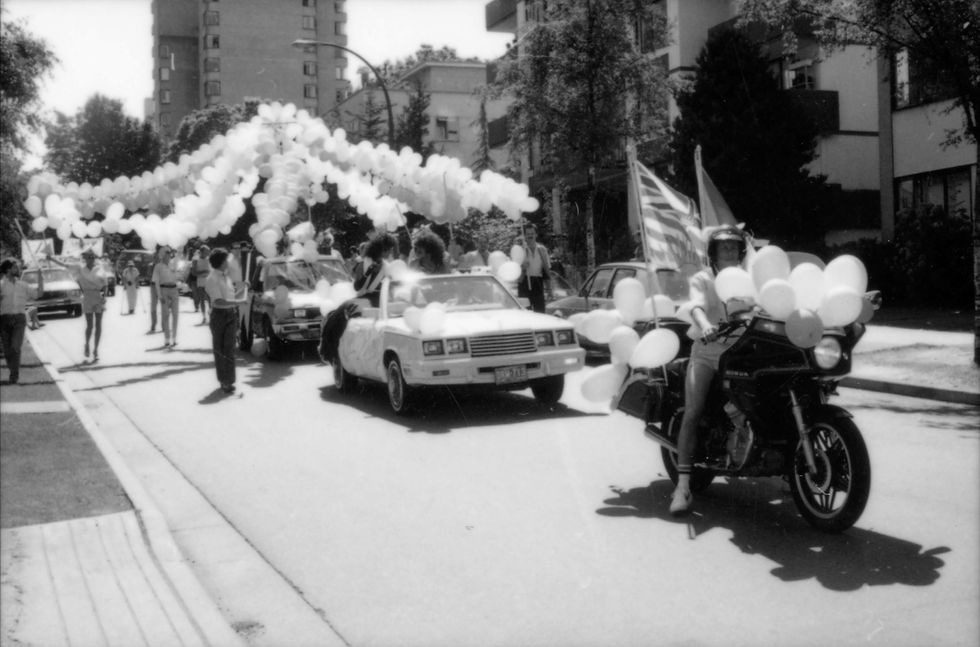
The August 5 parade was a huge success. Floats and other entries from a wide variety of businesses and community organizations formed a very decent sized parade which wound its way through West End streets.
This year, in marked difference from other years, large crowds thronged on sidewalks to cheer drag queens, Torch Song Trilogy’s surrey and magnificent floats. They pooh-poohed VASM‘s slave-drawn float or shouted “Harder! Harder!” as the VASM president paddled the treasurer.
As Gays and Lesbians of UBC were gathering signatures for a petition in support of a bill legalizing homosexual acts before the New Zealand parliament, promoters of the new Pacific Northwest newspaper The Eagle were passing out free copies to the crowd.

The 600-seat beer garden provided refreshment with a couple of short speeches and excellent entertainment — highlighted by Charlie Murphy from Seattle — kept the rally going long into the afternoon.
AIDS Vancouver raised an additional $1200 with a Pride Week boat cruise sponsored by the group and the American Association of Physicians for Human Rights.
Prizes for best floats and costumes went to MCC, the Zodiacs and John Barley’s, with Little Sister’s parade entry winning the award for best overall entry. The Lesbian Show won for best banner. The Elbow Room’s Patrice Savoie hosted the pre-parade continental breakfast at Nelson Park.

The Torch Song Trilogy benefit, which raised almost $1000 for the Vancouver Gay and Lesbian Community Centre (VGLCC), provided the perfect ending for a perfect day. The almost capacity crowd surpassed the expectations of the organizers and the cast gave an outstanding performance, which earned it a standing ovation. Cast and audience joined for a party at Friends Restaurant, which donated 10 per cent of the bar sales to VGLCC.
By Fred Gilbertson
Context
From paper bags to rainbow flags: The moving spectrum of Pride
Before the parades, there were the marches and demonstrations. In the 1970s, a few dozen gay men and their supporters met on what were then the Vancouver courthouse steps (now the front plaza of the Vancouver Art Gallery) to call for “gay rights” — equal protection under the law and an end to abusive policing. While some participants chose to dress conservatively to show how “normal” they were, others wore a paper bag over their head to show that they were at risk if their identity was seen in public.
By 1985, the Pride march was an organized event. Officially, it was called the Unity Parade to show that 2SLGBTQIA+ folks simply wanted to be recognized as one part of a broader society. Several hundred participated, and thousands more watched from the sidewalks and apartment balconies along the route. Floats represented community organizations and businesses.
Labour unions and social agencies were among the first organizations from straight society to take part, pushed by activists among their members. Within a few years, retailers and then banks appeared, drawn by the perception that earners with no family responsibilities must have money to spend.
(The support of mainstream businesses, it turns out, was only temporary. Major funders of Vancouver and Toronto’s Pride Parade, including Walmart, Google, Home Depot, Adidas, Clorox and Nissan Canada, abandoned the Toronto parade this year, while Mastercard, Nissan, Pepsi, Garnier, Target, Comcast, Anheuser-Busch and others have backed away from Pride events in the U.S.A. Under the Trump administration, it’s a bad business risk to be seen as supporting rights for 2SLGBTQIA+ people.)
Critics among the queer communities slammed organizers for moving away from the parade’s radical roots to become a toothless commercial entertainment. A 1986 issue of Angles featured a lengthy analysis of what was wrong with the parade and how to make it better.
By the 2020s, the Vancouver parade had become one of the biggest events in the city calendar. It moved to a longer route and a bigger space. Thorough planning ensured accessibility and a safe family space for all. The chaos, noise and excitement of the hot, sweaty crowds demonstrate the life it represents to the community.
Throughout B.C., Pride marches, parades, festivals, dances and parties now celebrate queer presence across a political and social spectrum that ranges from radical to mainstream. Search for What’s On Queer B.C. to find what’s happening near you. We are everywhere, and proud to be!
The pride parade has achieved a mainstream identity that reflects the mainstreaming of the 2SLGBTQIA+ community. If its political edge has dulled in places, events in the coming years may sharpen its focus to defend, celebrate and push forward equality for everyone.
— Richard Banner (he/him)
